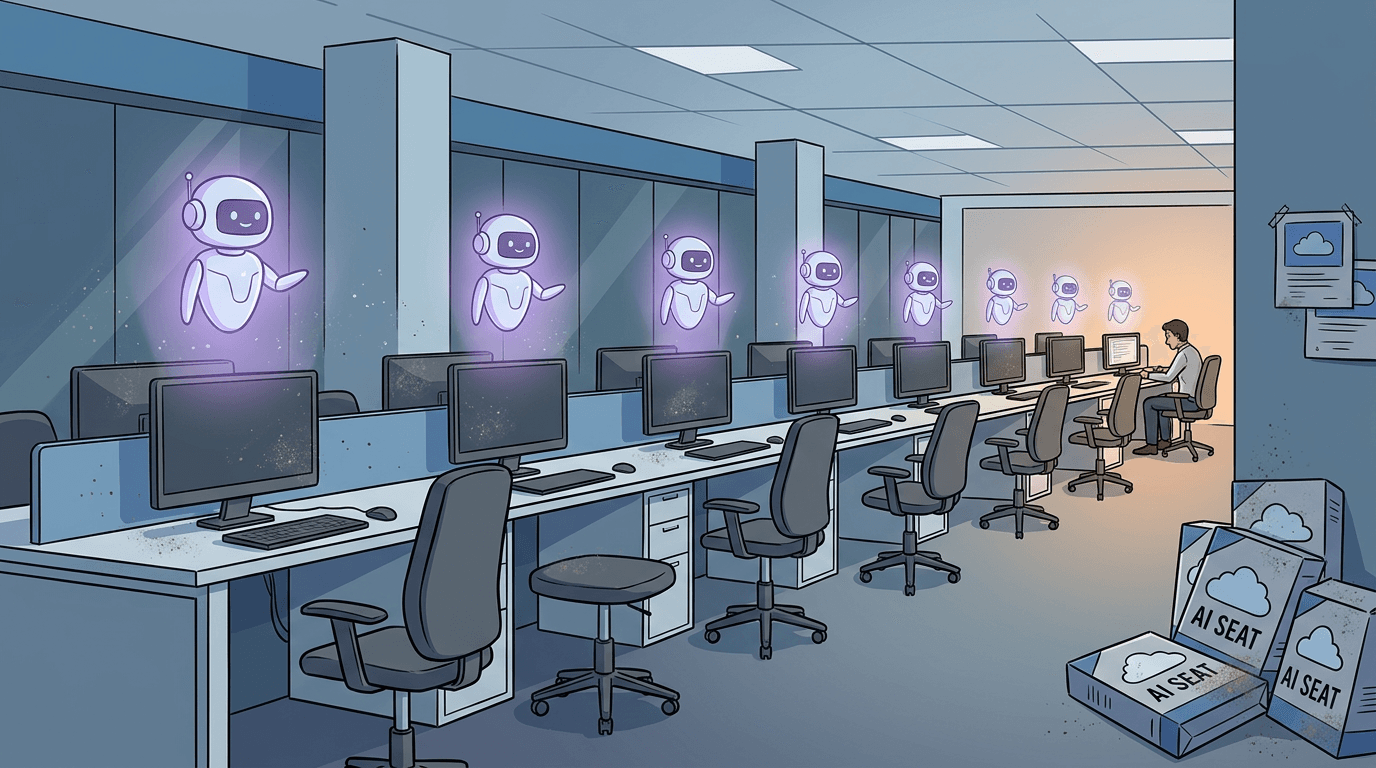
Why Most Companies Buy AI Seats but Nobody Uses Them
Most companies don't have an AI problem. They have a workflow problem.
That's why so many AI seats go unused.
Management buys the licenses. A few people play with them for a week or two. Someone rewrites an email, summarizes a report, maybe asks for help with an Excel formula. Then the excitement fades and the subscription becomes background noise.
I've seen enough of this pattern that I don't think the main issue is lack of intelligence on the team.
I think the issue is that the tool gets introduced without a job.
People are told to "use AI" the same way people are told to "be more productive." It sounds good, but it doesn't connect to a concrete workflow. No one explains where the tool fits, which tasks it should help with, what good usage looks like, or where the business will actually feel the gain.
So employees do the most obvious low-risk thing.
They use it for drafting.
Maybe summarizing.
Maybe rewriting.
Those are fine. I use AI for that too sometimes. But those use cases usually create small gains, not operational change. If the whole rollout stops there, the company ends up paying for an expensive writing assistant that only a few curious people touch.
Then management concludes one of two things:
Either the staff is resistant.
Or AI was overhyped.
Sometimes those are partly true. But I think the bigger miss is simpler than that.
The workflow never changed.
That's the thing.
You can't buy an AI license and expect behavior to change on its own. Tools don't become valuable because they exist. They become valuable when they are tied to recurring work in a way people can feel.
For example:
If a tool helps an employee write slightly better emails, that's useful but easy to ignore.
If a workflow automatically captures receipts, logs them cleanly, and saves a few hours every week, people notice.
If a system catches forgotten follow-ups before a customer starts complaining, people notice.
If reporting that used to take half a day now appears automatically every morning, people notice.
Concrete use cases beat training decks every time.
This is why I don't think adoption is mainly a training problem.
A lot of companies respond to weak usage by scheduling workshops. They'll bring everyone into a room, explain prompting, show a few examples, maybe even get people excited for an afternoon.
Then what?
They go back to the same workflow.
Same approvals.
Same handoffs.
Same spreadsheets.
Same unclear ownership.
So the tool becomes optional again. And optional tools usually lose to habit.
I also think most teams naturally split into three groups.
The first group is curious. These people will try new tools on their own. They're useful because they find edge cases and unexpected wins.
The second group is cautious. They won't resist if they see real value, but they won't explore much without examples.
The third group just ignores new tools unless the workflow forces a reason to care.
Only the first group creates adoption by default.
That is not enough for company-wide value.
If leadership wants broader usage, they need internal champions and visible proof. Somebody has to test concrete workflows, show what changed, and make the value obvious in normal business language.
Not "Here are the capabilities."
More like:
This task used to take 3 hours. Now it takes 20 minutes.
This report used to depend on one person. Now it updates automatically.
This recurring problem stopped happening after we changed the process.
That's the level where people pay attention.
There's also a mismatch in how companies imagine AI value.
Many employees use AI like a search box with extra steps. Ask a question. Get an answer. Maybe copy-paste the result somewhere. Again, that's fine. But that mode usually stays personal.
Operational value is different.
Operational value happens when AI is tied into systems, recurring tasks, triggers, approvals, reminders, reports, and decisions. That's when the business starts feeling the output, not just the employee using the tool.
And once the business feels the output, adoption becomes easier because the tool is no longer abstract.
It's attached to relief.
That's what most companies miss.
They buy the seats before they identify the friction.
I would reverse that.
Find the recurring bottlenecks first.
Look for tasks that are repetitive, neglected, slow, or error-prone.
Look for processes where people keep dropping the ball not because they are lazy, but because the workflow itself is weak.
Then ask whether AI belongs there.
Sometimes the answer will be yes.
Sometimes plain automation is enough.
Sometimes the best fix has nothing to do with AI and everything to do with clarifying ownership.
That last part matters because I think some companies buy AI as a proxy for doing the harder management work. It's easier to approve software budget than to redesign a broken process. Easier to say "let's roll out Copilot" than to ask why finance, sales, and operations still don't share clean visibility on the same information.
But if the process is weak, the tool just lands on top of the mess.
Then nobody uses it.
Or worse, a few people use it in random ways that never compound into organizational value.
So when I hear that a company bought a lot of AI seats and usage stayed low, I don't immediately think the employees failed.
I think:
What job was the tool hired to do?
Was that job clear?
Was the workflow redesigned around it?
Did anyone prove the value with a real use case?
If the answers are vague, the outcome is predictable.
Unused AI subscriptions are usually not a technology problem.
They're evidence that the company bought capability before it defined need.
And need is where adoption starts.
Note: I use AI as a writing and thinking tool. The ideas, examples, and judgment in this post are mine.