I Saved 2-4 Hours a Week With One Telegram Bot
My employees hated recording receipts. Honestly, I didn't blame them.
It was tedious work.
Before this workflow, receipt recording was one of those tasks that kept happening but nobody really wanted to own. Someone had to manually encode the company name, address, TIN, amount, and other details into a spreadsheet. It took around 2-4 hours a week. Sometimes more when receipts piled up.
The bigger problem wasn't just the time.
It was the incompleteness.
When work is repetitive and boring, people skip steps. That's not a character flaw. That's just what happens. The encoder would sometimes miss entries or leave out details. Which means when tax time comes around, you're not just dealing with a messy file. You're dealing with possible missed deductions because the supporting records aren't complete.
That gets expensive fast.
So I built a simple workflow.
Nothing fancy. No dramatic AI agent demo. No dashboard with glowing charts. Just something that removes a stupid repetitive task from the week.
Here's how it works:
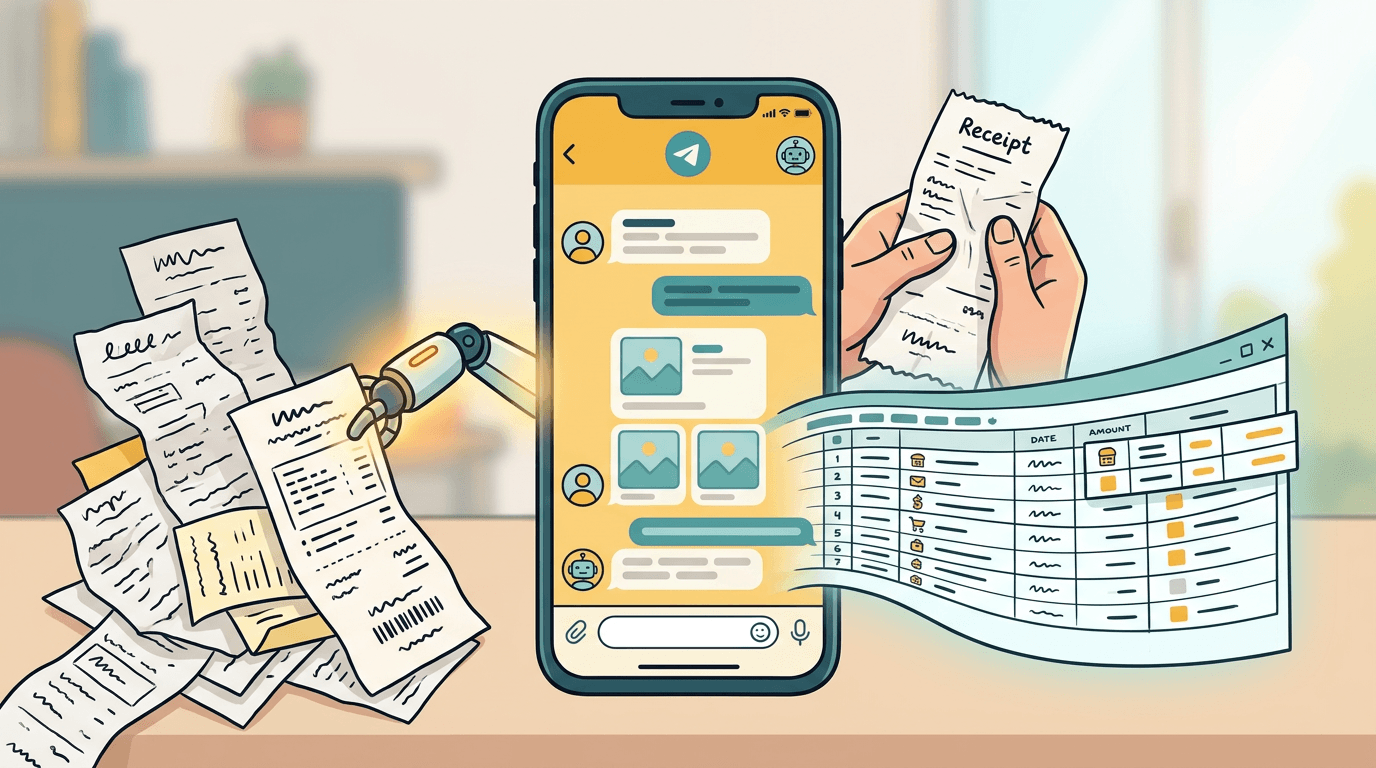
An employee takes a photo of a receipt.
They send it to Telegram.
An n8n workflow picks it up, extracts the details, and logs the company name, address, TIN number, and amount into a Google Sheet.
That's it.
From the employee's point of view, the whole system is basically: take photo, send message, done.
That simplicity matters more than people think.
Because the best workflow is not the smartest workflow. It's the one people will actually use without needing to be convinced every single time.
What changed after we set it up?
First, the obvious one: time.
We went from spending 2-4 hours a week on manual encoding to just reviewing the output and fixing the occasional edge case. The manual work didn't disappear completely, but it dropped hard.
Second, completeness.
This is the part I care about more.
The old workflow relied on somebody having enough patience to encode everything properly. The new workflow captures receipts as they happen. That means fewer things fall through the cracks. The records are more complete because the act required from the team is much smaller.
And third, tax impact.
This is where the boring workflow becomes useful in a very non-boring way.
If receipts are incomplete, badly recorded, or just missing, that's money left on the table. Not theoretical money. Real money. So when I say the workflow saves time, that's true. But I think the bigger value is that it improves record quality enough to protect deductions we would have otherwise risked losing.
That's a better story than "we automated something."
This is one reason I get a bit allergic to a lot of AI talk online.
Most of the examples people share are either too abstract or too flashy. They assume business owners want futuristic demos. From what I've seen, most business owners don't care about futuristic. They care about annoying things that keep happening every week.
Receipt encoding is not sexy.
But if you remove a task that wastes a few hours every week, improves compliance, and reduces the chance of missing tax records, that's real value.
It's not theory. It's what we tested.
The thing is, this workflow also changed how I think about "AI for business."
A lot of people think AI means chatbots, copilots, prompt hacks, or agents doing ten things at once. Maybe some of that matters later. But the first wins are usually smaller and more boring.
You look for a workflow with four traits:
- repetitive
- easy to trigger
- costly when neglected
- annoying enough that people avoid doing it properly
Receipt recording checked all four.
So it was a good candidate.
I also like this example because it passes the credibility test for me. I don't want to recommend workflows to other businesses that I haven't tested on my own operations first. It's too easy to sound smart in a meeting. It's harder to build something, run it in your own company, deal with the errors, fix the process, and then say, "Okay, this one actually worked."
This one worked.
Not perfectly, of course.
There are still edge cases. Bad lighting. Crumpled receipts. Weird formats. Inconsistent prints. Sometimes the output needs checking. That's normal. I think people get disappointed with automation because they expect magic instead of useful reduction.
Useful reduction is already gold.
If a task goes from 100% manual to 80-90% automated with quick review, that can still be a huge operational win.
And one more thing: the user experience matters as much as the automation itself.
I could have built something more elaborate. A special form. A dedicated internal app. A nicer interface.
But Telegram was already familiar.
That meant there was almost no training friction. No "please log into this new system." No forgotten passwords. No long explanation. The shortest distance between human behavior and system capture usually wins.
So if I had to summarize what I learned from this build, it's this:
The best automation projects don't start with the coolest tool.
They start with a boring pain point that happens every week.
Then you solve it in the least disruptive way possible.
For us, that meant one Telegram bot, one workflow, one spreadsheet, and a lot less manual encoding.
2-4 hours a week saved is already good.
But I think the more important part is this: we stopped depending on people to be consistently patient with a tedious task.
That is where a lot of operational leakage comes from.
Not bad people. Bad process design.
If you're running a business, you probably have your own version of this.
Maybe it's receipts. Maybe it's follow-ups. Maybe it's stock updates, reports, or supplier confirmations.
The question isn't "How do I use AI?"
The better question is:
What's the repetitive task everybody quietly hates, and what happens if it gets neglected?
That's usually where the first good workflow is hiding.
Note: I use AI as a writing and thinking tool. The ideas, examples, and judgment in this post are mine.